 @Alex Towle.
“Long term returns of convertibles have been similar to that of equities. It’s a nice asset class to consider as a way to be very efficient from a capital perspective.”
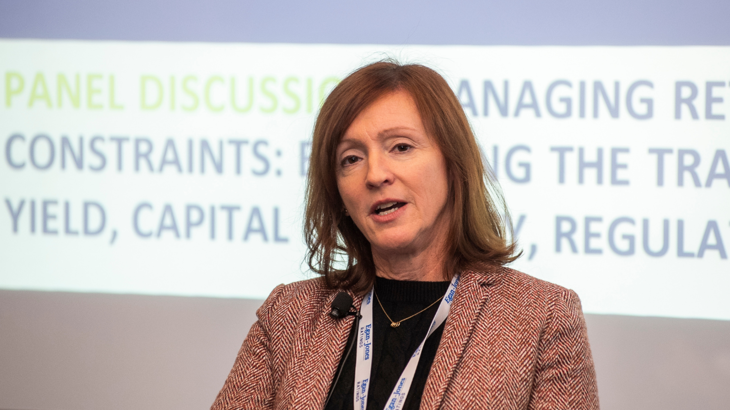
Those were the words of David Hulme, Managing Director and Portfolio Manager at Advent Capital, during the panel “Managing returns and constraints: exploring the trade-offs between yield, capital efficiency, regulation, and liquidity”, at the Insurance Investor Live | North America event, which also featured Diane Young, Chief Investment Officer at Gore Mutual Insurance and a representative from TIAA.
Getting the most return on investment was a major theme at the event, and many talked about piling into the convertible bond space as an effective way to do so.
However, they also highlighted the complexities of the market. Especially when understanding the heavy regulatory constraints around convertibles in some jurisdictions.
Traditionally, according to Hulme, insurers would go into equities to get “a higher total return". But, Hulme said, “there is a capital charge associated with that”, which could be “15% for a property and casualty (P&C) company".
“Long-term returns of convertibles have been similar to that of equities."
With convertibles, returns could range between 2–6%, “depending if it's investment grade or below investment grade,” he said.
All this coalesces into a theme that has been a favourite among those managing portfolios for some time: increased diversification.
“Long-term returns of convertibles have been similar to that of equities. It’s a nice asset class to consider as a way to be very efficient from a capital perspective," said Hulme. "It also offers diversification, because many convertible issuers don't have other fixed income outstanding.”
This is also for insurers investing outside North America: according to Manulife Investment Management, convertibles “receive favourable treatment under Solvency II capital guidelines, allowing insurance portfolios to achieve equity-like returns with considerably lower capital requirements.”
While certain equity strategies still might make more of a profit, insurers would have to put down “almost twice the capital requirement levels of convertible bonds”.
Hulme’s clients commonly “allocate between three to 5% of their portfolio to convertibles.”
If one looks at the return on that investment over the span of 10 years, Hulme added, that it would give you a total return of 28 basis points.
"[The asset class] is utilised in Europe, but for many insurance companies in the US, it's a bit more nascent," he said. "There’s an education process that is required. But once they become familiar, they tend to become very loyal clients.”
“The regulatory framework in Canada is more stringent than in the US. Liquidity is an issue in Canada.”
However, while the US is now seeing growth, in some parts of North America, the asset class is harder to invest in.
In Canada, convertibles are heavily regulated.
“The regulatory framework in Canada is more stringent than in the US. Liquidity is an issue in Canada,” said Diane Young, CIO at Gore Mutual, an Ontario-based mutual. She added that while she has learnt a lot about convertibles, she doesn’t have access to them in Canada.
She added that the high-yield market in Canada is "very limited” and that in the domestic market, you can find “A few resource companies, a few media companies", but the market was restricted and fairly nascent.
This regulatory environment, Young said, added to the complexities of being a mutual company - with its capital limits - and trying to compete with the bigger, and less constrained players in the market.
“We are constantly looking for extra yield,” said Young. “The trouble is the liabilities are so short that you're so limited in the curve you have to work with,” she said.
“The constraints that are imposed upon us by those capital charges by the Canadian federal regulator [the Office of the Superintendent of Financial Institutions (OSFI)] are pretty material," she said. "We're limited by that hurdle rate. If we want to put money into commercial mortgages, which is an asset that is great for P&C companies because of the short duration, it carries a 10 % capital charge.”
Young added that the company has to “balance off, how much do we think we can earn in our modelling scenario testing".
Then, the company is consistently trying to optimise “what we can allocate, of course, thinking about our liabilities, but then also thinking about what is our best rate of return after the capital charges.”
Equities are notoriously volatile, and insurers usually hold some exposure but not a lot due to their onerous liquidity requirements.
Concerns such as these highlight the uneven playing field many are working on. With convertibles receiving a similar ROI as equities and as the asset functions like debt and equity, insurers could get safer returns, if their jurisdiction allows.